

Your cart is empty
Total:
0đ
EU and UNDP Support Sustainable Livelihood Development Under Forest Canopies

Composer by at 08/07/2026
That is how a project in Lam Dong, with support from the European Union and UNDP, helps connect economic development with long-term nature conservation.
The European Union recognizes Malaysian palm oil certification as compliant with the EUDR.
Proactively implementing solutions to promote the circular economy, sustainable production and consumption, and sustainable trade in line with the European Union’s green policies.
The European Union steps up support for the implementation of the JETP.
UNDP and Norway launch a USD 1.2 million initiative to promote the blue economy.
Livelihoods and Forests in a Shared Development Agenda In many communities bordering forests in Lam Dong, local livelihoods have long depended on the land, water resources, and surrounding natural ecosystems. However, as new demands for sustainable development emerge, the challenge is no longer simply how to protect forests, but also how to enable local people to increase their incomes and build sustainable livelihoods while making productive use of the land they already cultivate.
Building on this approach, the project **“Integrated Sustainable Landscape Management Through a Jurisdictional Approach to Deforestation-Free Development in Lam Dong”**, funded by the **European Union (EU)** through the **United Nations Development Programme (UNDP)**, is being implemented to promote a balanced and sustainable development model.
With a total budget of **EUR 5 million**, the project aims to reduce deforestation and forest degradation, conserve biodiversity, and create sustainable development opportunities for local communities, particularly households living in forest-adjacent areas.
**Enhancing Livelihoods Through Sustainable Farming Practices
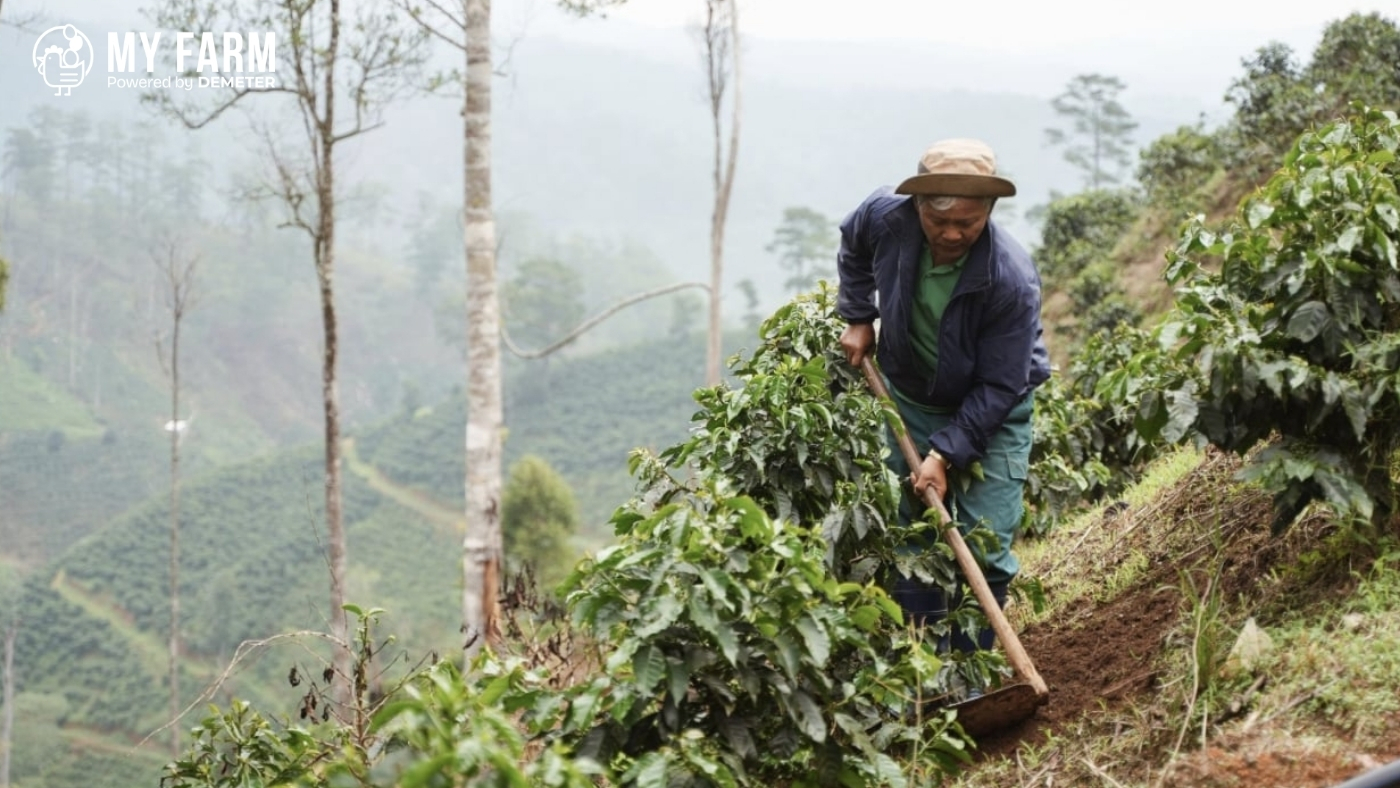
The project's impact is gradually becoming evident through changes in the way farmers manage their plantations.
In coffee-growing areas, instead of completely clearing weeds beneath coffee trees, many farmers now preserve natural ground cover to improve soil moisture retention and reduce erosion. Agricultural by-products, such as coffee husks, are recycled into organic compost. The use of fertilizers and irrigation water is also being managed more efficiently, helping to reduce input costs while improving agricultural productivity.
In addition, many households have adopted intercropping systems by growing coffee alongside other crops such as durian. This approach not only diversifies income sources but also increases canopy cover, improves growing conditions for crops, and enhances resilience to changing weather conditions.
“Our family has gradually changed the way we farm by using fertilizers more efficiently and managing our plantation more effectively to improve productivity,” said Lieng Jrang Ha Dan, a farmer participating in the project.
Toward a Deforestation-Free Development Model
According to Vu Thai Truong, Head of the Environment, Energy and Climate Change Unit at UNDP Viet Nam, the “sustainable landscape” approach promoted by UNDP represents a shift from a sector-based mindset to viewing the entire ecosystem as an integrated whole. Rather than treating agriculture, forestry, and economic development as separate sectors, this approach addresses livelihoods, nature conservation, and climate resilience simultaneously.
Hoang Thanh, Programme Manager at the European Union Delegation to Viet Nam, noted:
“As farmers, cooperatives, and businesses progressively meet the green requirements of both domestic and international markets, Vietnamese agricultural products can build stronger trust and branding, increase their value, and integrate more deeply into high-value, sustainable global supply chains.”
For the European Union, through the collaboration of UNDP and international technical partners, these experiences are being adapted and applied to suit Vietnam’s local conditions and development context.
Source: Phuong Linh – Agriculture and Environment Newspaper


 0903344277

